
He Knows His Letter Sounds but Can't Blend Them — Here's What to Do Tonight
Your child can say c–a–t but the word never clicks into 'cat.' This is one of the most common — and most fixable — reading snags. Here's exactly what to do.

You've done everything right. Your child knows their letter sounds cold. Point to any letter and they'll tell you: /c/, /a/, /t/. So they sit down with a simple word, sound out each letter perfectly… and then say a completely different word. Or just look at you, stuck. They know every sound and the word still never clicks.
I have been at that exact table, thinking, how is this so close and so impossible at the same time? So first: this is not you doing it wrong, and it's not your kid failing. This is one of the single most common places kids get stuck, and it's one of the most fixable. There's even a name for the missing skill: blending. Knowing the sounds and blending the sounds are two different skills. Your child has the first one. Tonight we work on the second.
Why this happens
Here's the key idea: saying "c… a… t" out loud is not the same skill as smooshing those sounds into "cat." When a child sounds out letter by letter, there's a little pause between each sound, and those pauses are exactly where the word falls apart. The brain hears three separate, disconnected sounds and can't hear that they add up to a word it already knows.
Sometimes there's a second culprit: extra "uh" sounds. If your child says "cuh–a–tuh," those extra uh sounds glued onto the consonants ("cuh," "tuh") turn "cat" into "cuhatuh," which sounds like nothing. Cleaning up the sounds themselves often unlocks blending on its own.
The fix, in both cases, is to close the gaps between the sounds.
Tonight's 10-minute plan
You don't need a program or a purchase for this. You need a few short words and about ten calm minutes. Do these in order.
Step 1: Clean up the sounds (2 minutes)
Do not clip every consonant. Some consonant sounds are continuous: /m/, /s/, /f/, /n/, /l/, and /r/ can be held without changing the sound. Hold those as you move into the next sound. Stop sounds such as /c/ and /t/ are quick; say them cleanly without adding “uh.” The goal is /c/, not “cuh,” and /t/, not “tuh.”
Step 2: Try "continuous blending" (3 minutes)
Start with a word that begins with a continuous sound. Point to m in man and hold /mmm/; keep your voice moving as you point to a and say /aaa/; finish with /n/, then say the word: “mmmaaannn … man.” Then have your child try. For a word that begins with a stop sound, such as cat, make the first sound quick and move straight into the vowel. Do not stretch /c/ or add “uh”; connect it by avoiding a pause.
To check one word without turning practice into a test, hide the letters, say /s/ /u/ /n/, and ask, “What word do those sounds make?” Then show s u n and ask your child to point to each letter, say its sound, and join the sounds. If sun works without print but gets stuck when the letters appear, you have observed a difference on this one word between combining spoken sounds and reading the letters. Use that as a practice clue, not a diagnosis or proof of mastery.

Step 3: Blend in two chunks, not three (3 minutes)
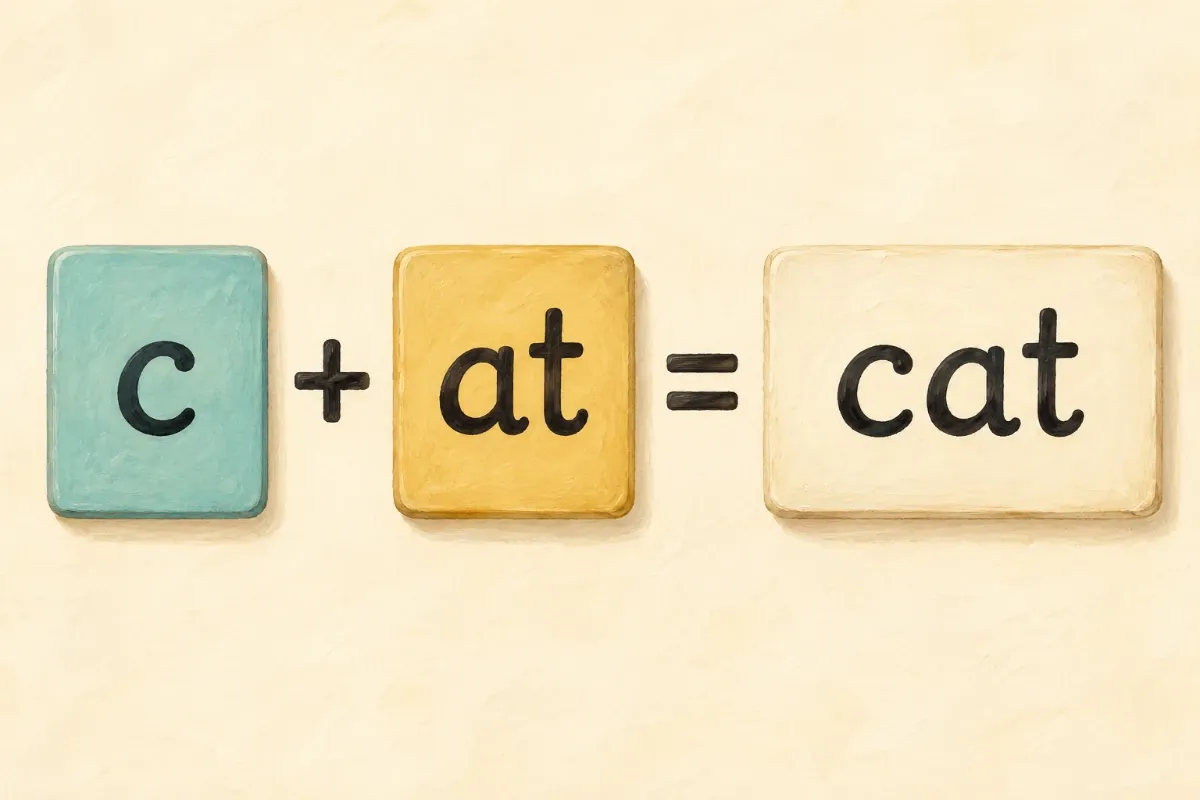
If sound-by-sound still isn't clicking, break the word differently. Blend the last two sounds first: for cat, have them say "at" as one piece, then add the front: /c/ … "at" … "cat." Front sound + the rest. Kids who can't do c-a-t can very often do c-"at," because you've turned three moving parts into two. This is a genuinely powerful move.
Step 4: Make it physical (2 minutes)
Put out three tiles, blocks, or even three coins, one per sound. As your child says each sound, they touch a tile. Then slide the tiles together into a pile while sliding the sounds together into a word: "/c/–/a/–/t/… caaat!" The physical sliding together mirrors the mental blending. Some kids need to feel it with their hands before their mouth can do it. When you would like one more quick round, Stretchy Blend is a free, short game where your child slides through each sound and hears them blend into a word.
Tips that keep practice calm and fun
- Keep the words short and truly decodable. Real CVC words only: cat, sun, map, pig, top, bed, hat, run. Hold back words with a tricky pattern he hasn't learned yet, so he can succeed.
- Model constantly. Blend it for him, then have him copy you. "Watch me: sssuuun, sun. Now you." Imitation is teaching, not cheating.
- Stop while it's still going okay. Ten good minutes beats twenty that end in tears. If you're already dreading these sessions, read When Reading Ends in Tears. The routine matters as much as the skill.
- Celebrate the click, loudly. The first time c–a–t becomes "cat" for real, make a big deal of it. That feeling of the word appearing is what you want him chasing.
A note on why the sounds matter so much
Reading is fundamentally a sound skill. A child can't blend sounds they can't clearly hear, so the biggest lever you have at home is your own voice: model the sounds out loud, cleanly, over and over, and let your child copy you.
What "getting better" looks like
You're not looking for instant fluency. You're looking for the pause between the sounds to shrink. First he'll blend a word after real effort. Then a little faster. Then, one day, he'll just… read the word, and look almost surprised. That's the alphabetic principle clicking into place: the understanding that letters make sounds and sounds make words. Once it clicks on a few words, it tends to generalize to many.
Blending is often the last big step before reading opens up. Your child knows the sounds, which is the hard-won part and most of the work. Tonight you're just teaching him to slide them together. Ten minutes, a few short words, no pressure.
If, after a few weeks of this, blending still isn't budging at all, it's worth reading Is It Dyslexia, or Is My Child Just Behind? to see what a little extra help can look like. But most kids who "know their sounds but can't blend" just need blending taught directly, warmly, and out loud. Start tonight.
Try ReadPals for short, playful practice
ReadPals gives your child short, playful phonics lessons. Each lesson is planned from what your child just showed they can do, so practice always fits where they are, and a plain-language progress view shows you what they've learned and what's coming next. It's an easy way to keep blending practice going after tonight.